A reader’s curiosity. A little practice. Your support.
How Luxozoa works
Free reading comprehension practice, built around what your reader wants to know.
Luxozoa is a reading app for kids and teens, with a family member or teacher in their corner. Your reader brings a topic. Page, our AI reading companion, writes a passage at their estimated reading level and asks questions about its meaning. You can review the work and help them think it through.
If your child can read the words but struggles to explain them, this gives you a place to practice together. It’s supplemental practice alongside books, lessons and adult instruction.
No account needed to try. No subscription, in-app purchases or in-product ads.
01 / Inside a reading session
From “tell me about…” to “how do you know?”
Meet Sam, a fictional reader interested in octopuses, and Jordan, the adult supervising Sam. These screenshots show actual Luxozoa screens using fictional accounts. The reading and saved answers come from the same demonstration session; they are not evidence of learning gains.
Start with an interest
On the first visit, a signed-in reader can choose interests to help get a conversation started. They can also type their own message. Sam asks Page about octopuses.
Read, then explain the meaning
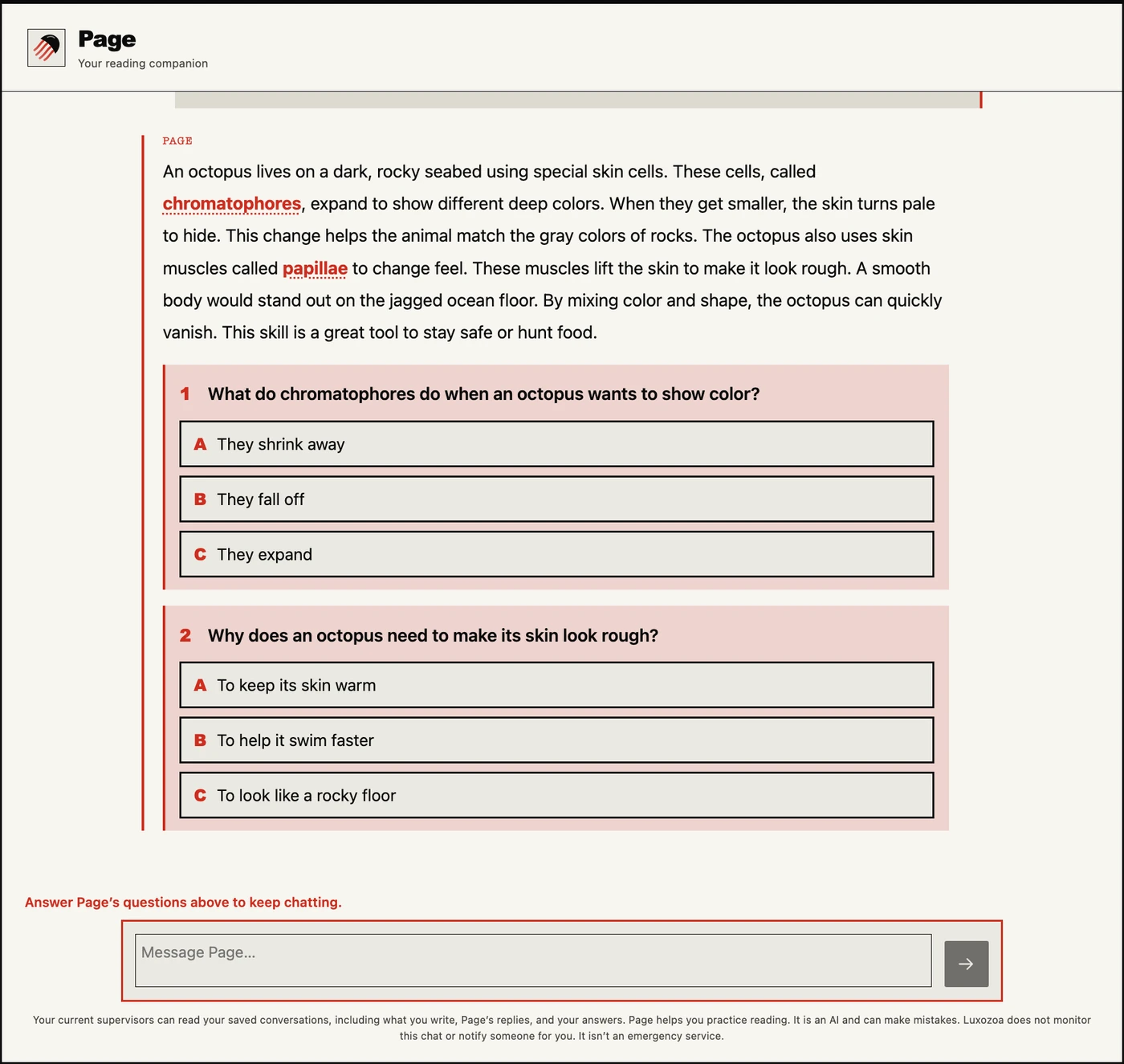
The questions ask the reader to use the passage, rather than simply finish scrolling. Here is the actual passage and question set from Sam’s example, as readable text:
Sam’s message
Explain how an octopus uses camouflage to hide on a rocky seabed. I want to learn the biology, rather than news.
Page’s passage
An octopus lives on a dark, rocky seabed using special skin cells. These cells, called chromatophores, expand to show different deep colors. When they get smaller, the skin turns pale to hide. This change helps the animal match the gray colors of rocks. The octopus also uses skin muscles called papillae to change feel. These muscles lift the skin to make it look rough. A smooth body would stand out on the jagged ocean floor. By mixing color and shape, the octopus can quickly vanish. This skill is a great tool to stay safe or hunt food.
Question 1
What do chromatophores do when an octopus wants to show color?
- They shrink away
- They fall off
- They expand
What this practices: Finding a stated detail: the passage says the cells expand to show colors.
Question 2
Why does an octopus need to make its skin look rough?
- To keep its skin warm
- To help it swim faster
- To look like a rocky floor
What this practices: Connecting the explanation to its purpose: a smooth body would stand out, so rough skin helps the octopus resemble the rocks.
Sam’s demonstration answer: “They shrink away”
We deliberately select A for question 1. Page’s actual feedback is:
The answer is “They expand.” The text states that chromatophores expand to show colors, which helps the octopus blend in.
Question 2’s answer is C, “To look like a rocky floor.” The reader needs to connect the rough skin with the rocky surroundings.
An adult accuracy check: Page’s phrase “skin muscles called papillae” is imprecise. Papillae are skin projections raised by muscles. We’ve kept the actual reply here; an adult can use the Smithsonian’s explanation of camouflage to discuss the distinction. AI answers deserve review, even when the main idea makes sense.
Use the feedback
For this demonstration, we deliberately choose one incorrect answer. Page reveals the answer and an explanation. A correctly answered multiple-choice question clears from the reading pane; an incorrect answer stays visible with feedback. This gives Sam and Jordan something specific to discuss: which sentence supports the answer?
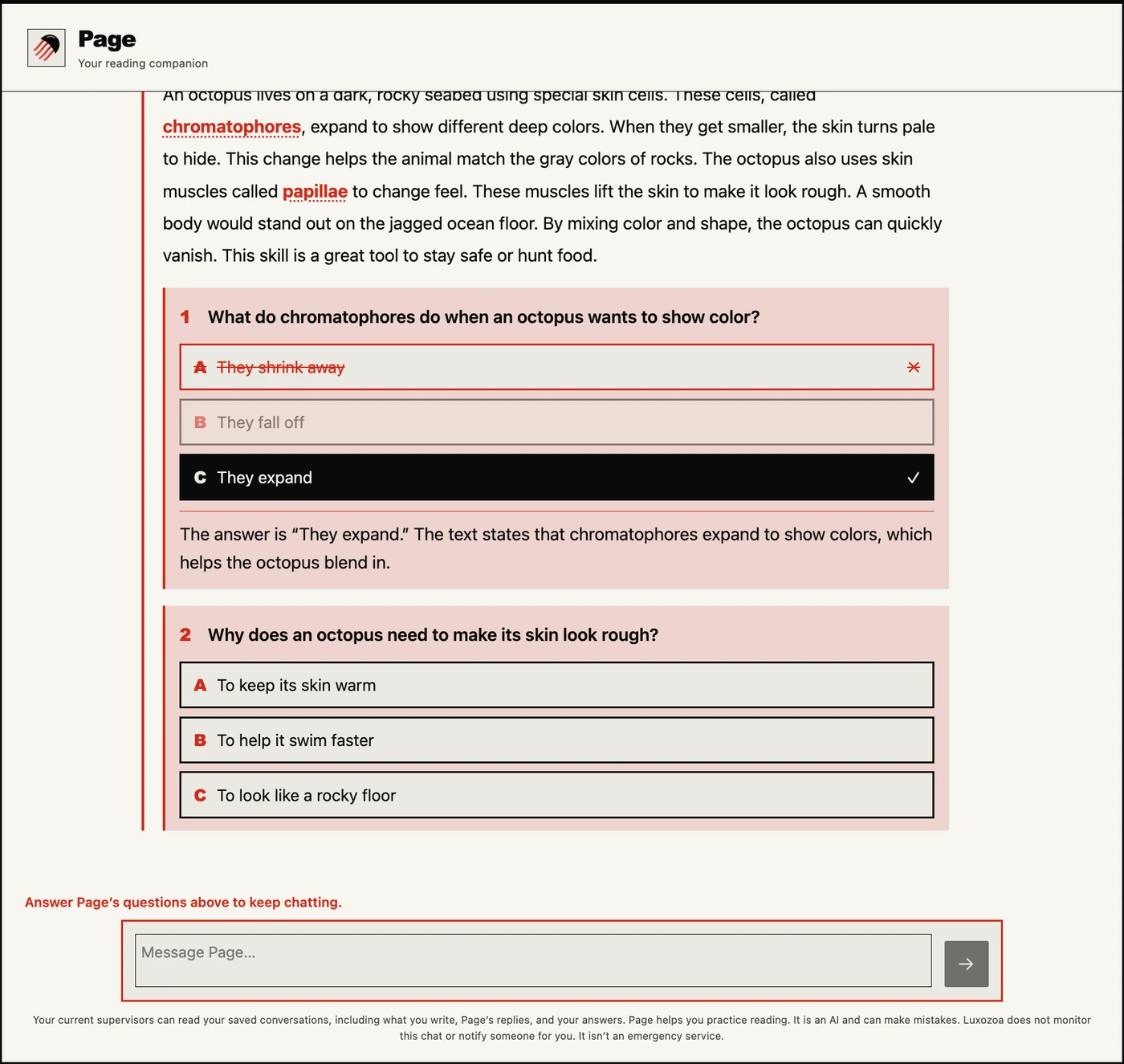
After answering the questions, the reader can choose one of Page’s follow-up ideas or type another message. A question about an animal might lead to its habitat, defenses or diet. The number and kinds of questions vary; signed-in practice can include written answers at higher levels. Public Try uses multiple choice.
02 / Finding a useful level
Practice that adjusts as they answer
Page aims its language at an estimated reading level. As the reader answers, Luxozoa updates that estimate and uses it to guide later passages. Passage length can adjust too, as the reader completes question sets. Language difficulty and length are separate parts of the experience.
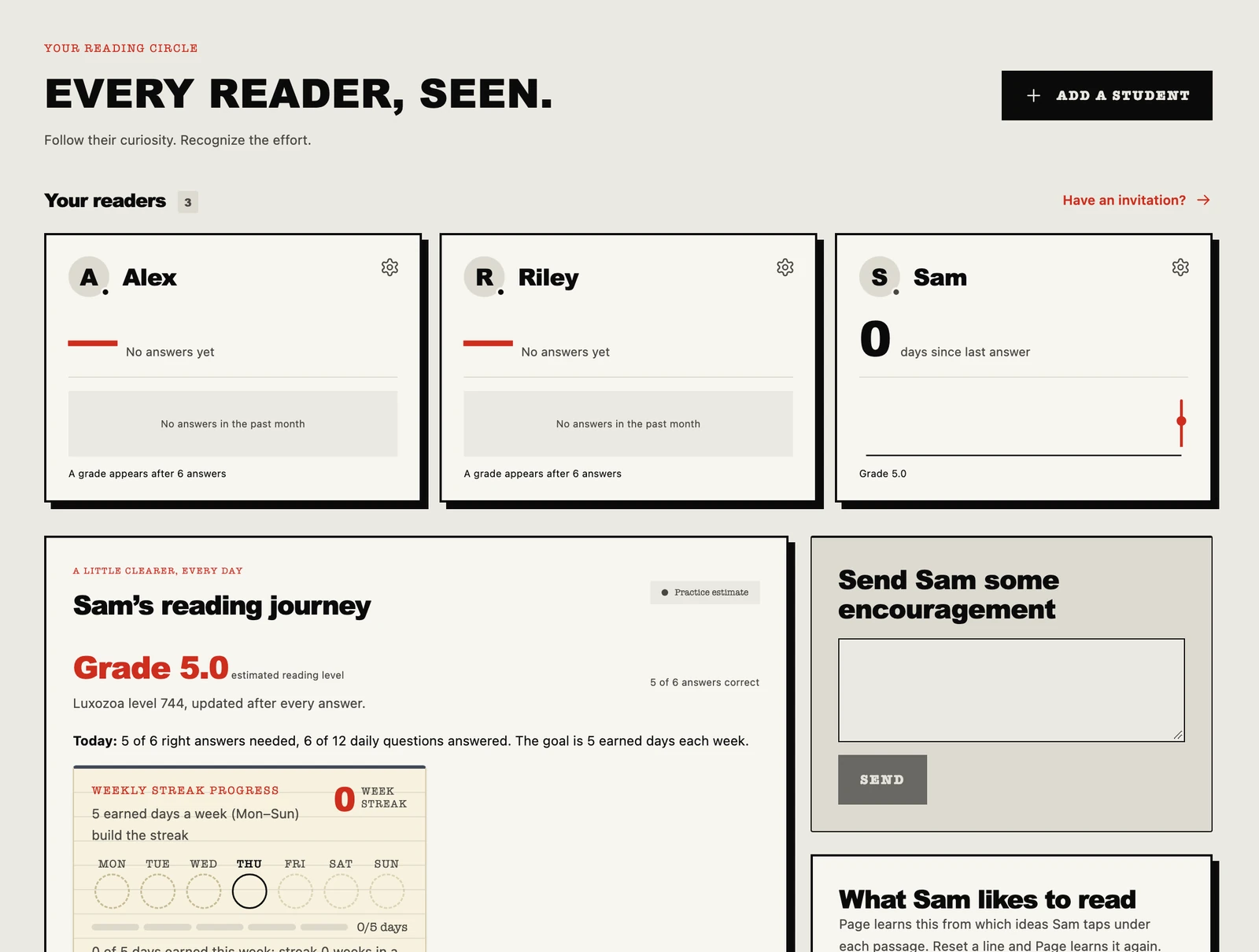
The starting estimate becomes better informed through practice. After six answers, the adult can see an estimated reading grade. Students don’t see a grade. An estimate may stay flat or move down as well as up; familiarity with a topic and the quality of an AI-generated question can affect an answer.
03 / The adult’s part
See progress and focus your encouragement
You can review all of a reader’s saved work, but you don’t have to review every passage or answer. Page keeps providing new passages and questions, adjusting to the reader’s estimated level as they continue practicing day after day, within the daily limits. Practice doesn’t wait for you to review or approve the previous session.
A quick look at your dashboard shows each reader’s estimated level and recent activity, so you can see who is practicing regularly and who may need a nudge. Focus your encouragement on the readers who need it most, without opening every conversation. For a closer look, check today’s correct-answer goal, weekly goal days and streak, and their practice estimate once enough answers are available. Question-type totals offer another view of practice; they aren’t a diagnostic assessment of individual skills.
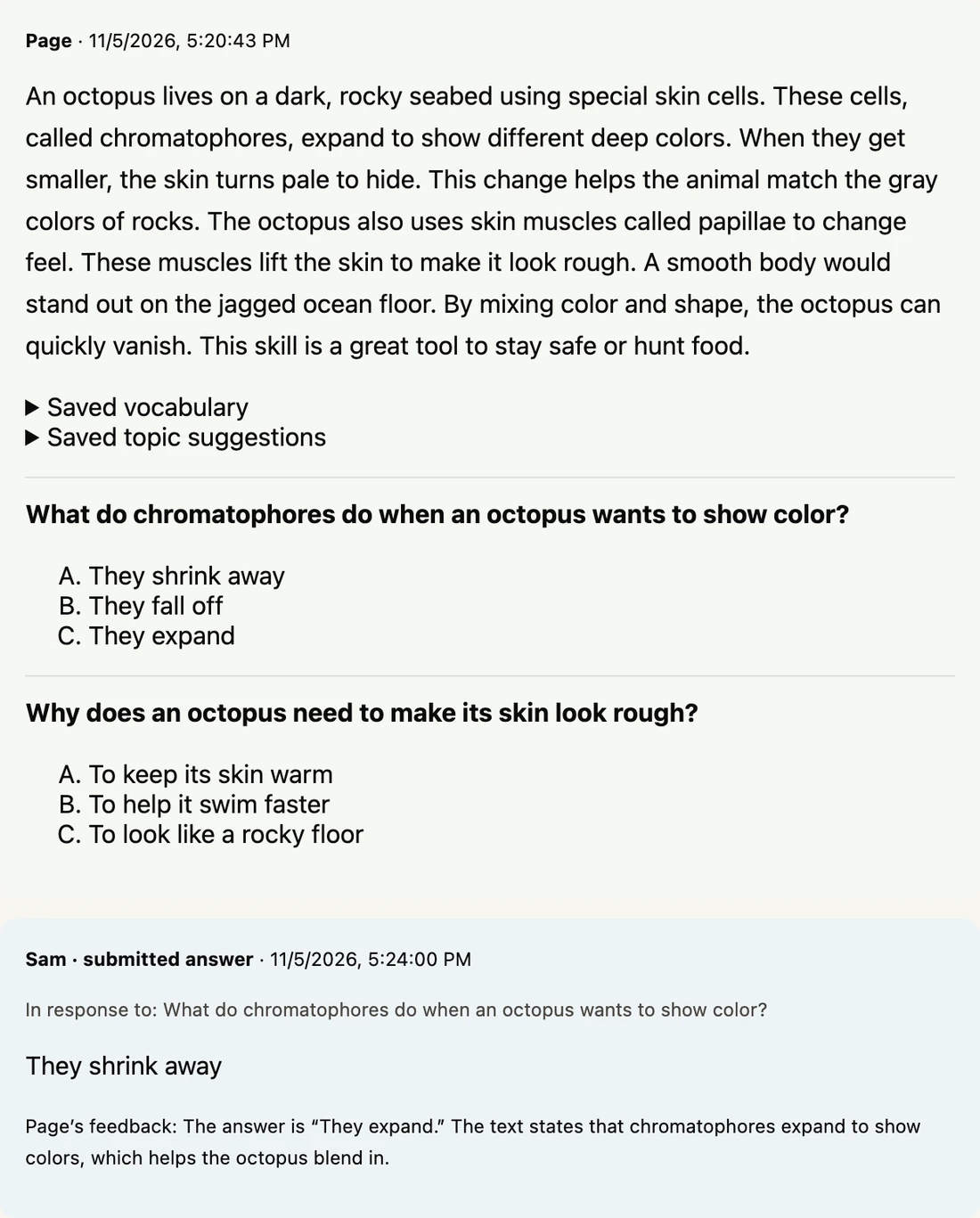
Open a reader’s saved conversations to review the passages, questions, answers and feedback. You can see what prompted an incorrect response and ask the reader to explain their reasoning. Encountered vocabulary gives you words to revisit together; encountering a word doesn’t mean the reader has mastered it.
You can send encouragement into the reading space and choose the optional weekly progress email. The dashboard is useful whether or not you receive email. You choose when to look more closely and follow up with a reader. Luxozoa does not monitor conversations on your behalf; you remain the supervising adult.
04 / Home & homeschool
A small routine you can make your own
Here’s one way a family or homeschool educator could use Luxozoa. This is a suggested routine, not a proven amount of practice:
- Choose something worth reading about. Let the reader bring an interest, or invite them to ask about a topic connected with today’s books or lessons.
- Read and answer. Give them space to think, and encourage them to return to the passage when they’re unsure.
- Talk about one thing. Ask “What made you choose that answer?” or pick an encountered word to explain in their own words.
A small daily correct-answer goal gives practice a stopping point to aim for. Reaching it five days in a week fills the weekly streak card. Hitting the goal doesn’t immediately lock the reader out: some extra practice is available before the daily limit, when Page asks them to return tomorrow.
If you support more than one child, separate reader accounts let you review each one individually. Use the conversations alongside your existing teaching; Luxozoa is not a complete homeschool curriculum, a phonics program or a demonstrated intervention for a diagnosed reading difficulty.
05 / For teachers
Your students read. You stay involved.
Families and teachers use the same adult account. A teacher might use Luxozoa for independent supplemental practice, a reading station or a brief check-in followed by discussion. Each reader brings their own topic; these are ideas for using the current product, not teacher assignment controls.
See each student’s estimated reading level and recent activity in your roster, then open their progress view to see how their estimate is changing over time. The optional class leaderboard shows whose practice estimate is rising fastest with “Most improved this week,” alongside longest streak and correct answers this week.
Use these views to build fun class reading competitions: celebrate improvement, consistent practice or answering more questions correctly. To share a class leaderboard, turn it on in Preferences and choose “Your class.” It’s off by default and needs at least three readers. Students see names, the top three in each category and their own place; their reading levels and conversations stay private from classmates.
- Create your free adult account and verify your email. Try Page first if you want to understand the reading experience before enrolling anyone.
- Add each student with the required permission. Teachers need their school’s authorization. Review the Privacy Policy and Terms, and contact us about school requirements before using it with students.
- Share each student’s private setup link. The student chooses a student ID and password. A student email address isn’t required. Treat the link as private.
- Review individual practice. Select a reader from your roster, check activity and open their saved conversations. Use the answers to guide your next discussion.
One adult can currently supervise up to 30 readers. Another authorized adult can connect through a private invitation, so a family member and teacher can both supervise a reader. Connecting an account does not replace the authorization or permission required for that student.
Our About page introduces the people building Luxozoa, and our Mission explains why we’re making reading practice freely available.
06 / Before you sign up
Try the reading. Then decide.
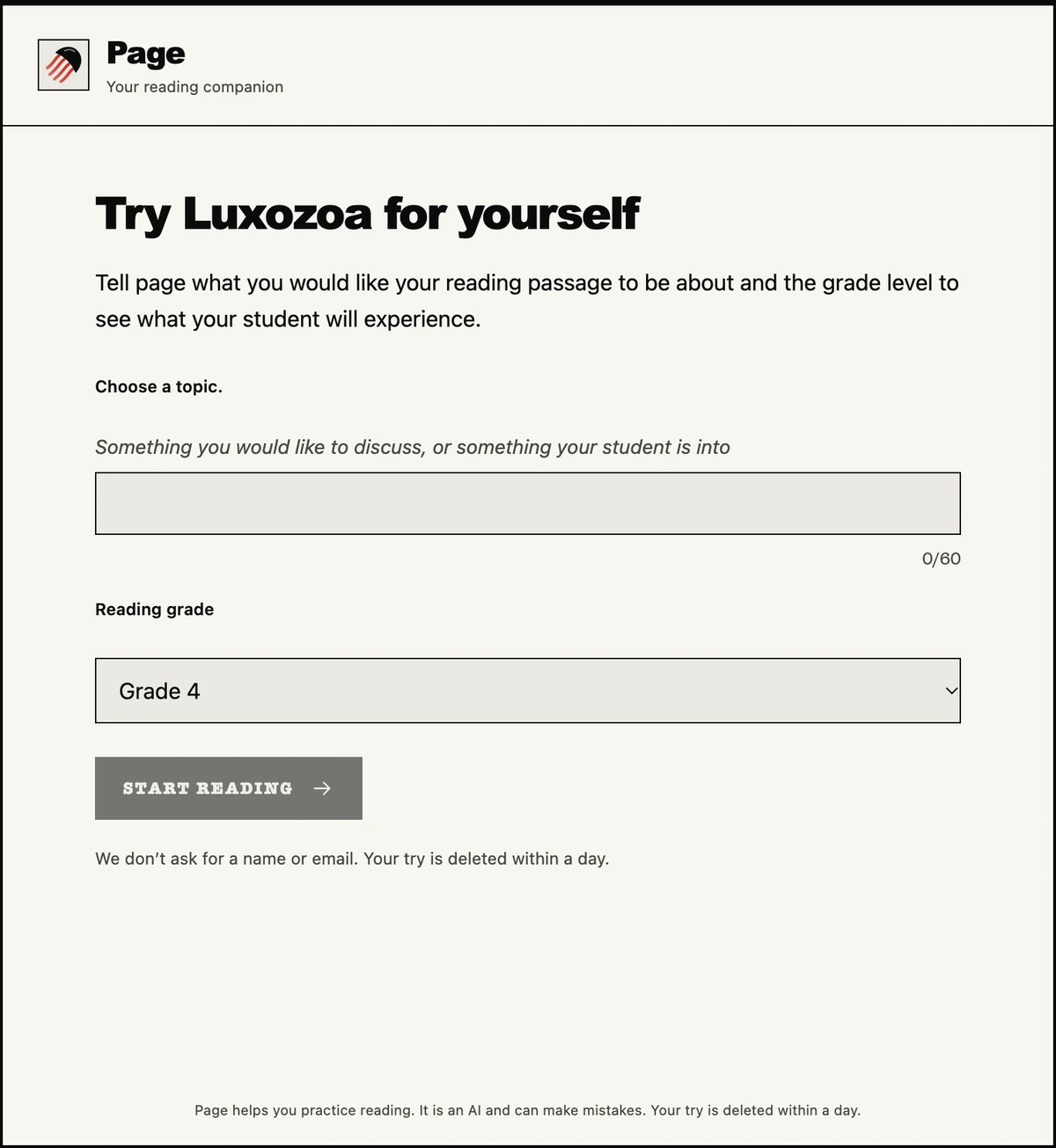
Public Try asks for a topic and reading grade, without asking for a name or email. It has a five-correct-answer goal and your try is deleted within a day. Account use saves practice history and progress, subject to the retention explained in our privacy policy.
The current offering is free, with no subscription, in-app purchases or in-product ads. An adult creates and supervises student accounts; students cannot register themselves.
Page uses AI and can make factual or grading mistakes. Check confusing examples together and use Share your feedback to report a problem. For information about account data, adult access, retention and analytics choices, read the Privacy Policy.
A few practical answers
Does my student need an email address?
No. Students sign in with their own student ID and password after using the private setup link from their adult.
Can I support several readers, or share supervision?
Yes. An adult can supervise up to 30 readers, with individual progress and conversations. A private invitation lets another authorized adult connect to the same reader.
Is this a complete curriculum or a formal reading test?
No. It’s supplemental comprehension practice. The estimated reading grade is an app practice estimate, not a standardized test result.
Can I see it before creating an account?
Yes. Try Page free with a topic and reading grade. For more questions, visit the FAQ or email hello@luxozoa.com.